






Texas Pipeline Damage Prevention Statistics

Pipeline Safety ANNOUNCEMENTS
Notice to Oil & Gas and Pipeline Operators
Winter Weather Outlook 2026October 02, 2026
The Railroad Commission of Texas consulted with the Office of the Texas State Climatologist regarding anticipated weather patterns for the upcoming year. The State Climatologist issued the following statement to the Commission:
“The upcoming winter is likely to feature an unusually strong El Niño. El Niño events are most commonly associated with cool and wet conditions across Texas. Because this event may be outside the historical envelope, past El Niño events may not be a good guide to this event. It is, however, reassuring that seasonal climate prediction models simulate average weather conditions that are similar to other past strong El Niños.
Historically, the cooler and wetter conditions during an El Niño have tended to increase seasonal snowfall totals in northern and western Texas. Lubbock had its highest snowfall total since 1950 during the strongest El Niño since 1950, and three of the next five largest snowfall totals occurred during moderate to strong El Niños. Eastern, central, and southern Texas do not exhibit a strong snowfall relationship to El Niño. Freezing rain throughout the state also exhibits little or no relationship to El Niño.
Over the longer term, the warming trend in place over the past several decades is expected to continue, while precipitation will continue to be dominated by strong year-to-year variability due to El Niño and other factors.” — John Nielsen-Gammon, Texas State Climatologist
The RRC maintains a 24-hour, toll-free emergency line at 844-773-0305 to report emergencies, including leaks or spills and damage to gas pipelines.
In addition, the RRC advises all operators to monitor and report road conditions during an extreme weather event.
- Report road conditions using the Road Conditions Reporting Form.
- Monitor Texas highway conditions information on the Drive Texas website at https://drivetexas.org/.
- Access the RRC Weatherization Practices Guidance Document (PDF).
To view the full notice, visit the RRC website at https://www.rrc.texas.gov/media/imeagig5/10012026-nto-winter-weather-forecast.pdf
Overview
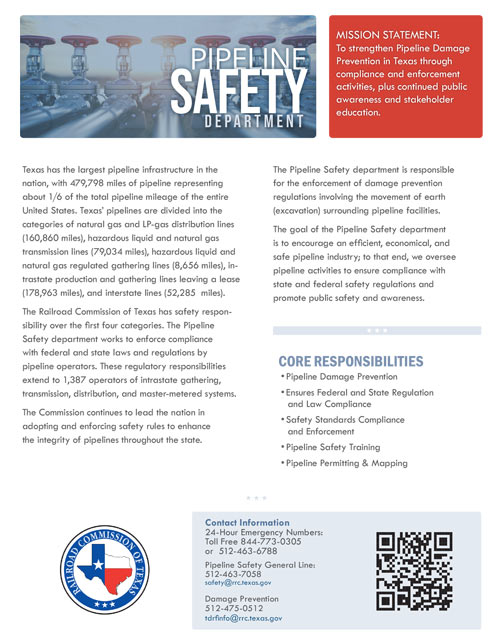
Printable Overview
What we do
The Oversight and Safety Division has responsibility for Alternative Fuels, Gas Services and Pipeline Safety. This reorganization in January 2015 will bring even greater efficiency and consistency to these operations within the Railroad Commission of Texas (RRC), allowing the agency to better serve the state.
Texas has the largest pipeline infrastructure in the nation, representing about 1/6 of the total pipeline mileage of the entire United States. Texas’ pipelines are divided into the categories of natural gas and LP-gas distribution lines, hazardous liquid and natural gas transmission lines, hazardous liquid and natural gas regulated gathering lines, intrastate production and gathering lines leaving a lease, and interstate lines. The RRC has safety responsibility over the first four categories.
Pipelines that cross between states are considered Interstate and would be under the jurisdiction of the U.S. Dept. of Transportation (DOT) - Pipeline and Hazardous Materials Safety Administration (PHMSA). The PHMSA southwest regional office located in Houston covers Arkansas, Louisiana, New Mexico, Oklahoma, and Texas.
The Pipeline Safety department works to enforce compliance with federal and state laws and regulations by pipeline operators. These regulatory responsibilities extend to operators of intrastate gathering, transmission, distribution, and master-metered systems. The RRC continues to lead the nation in adopting and enforcing safety rules to enhance the integrity of pipelines throughout the state.
Pipeline Safety rules administered by the RRC are adopted in the Texas Administrative Code, containing State specific requirements and incorporates by reference the minimum Federal safety standards for transportation of gas and hazardous liquids by pipeline and liquefied natural gas facilities.
The RRC also promotes and enforces an underground pipeline damage prevention program for Texas. The Pipeline Safety department is responsible for the enforcement of damage prevention regulations involving the movement of earth (excavation) surrounding pipeline facilities.
The goal of the Pipeline Safety department is to encourage an efficient, economical, and safe pipeline industry; to that end, we oversee pipeline activities to ensure compliance with state and federal safety regulations and promote public safety and awareness.
Commissioners
-
 Christi Craddick
Chairman -
 Wayne Christian
Commissioner -
 Jim Wright
Commissioner
Audiences